Non-Newtonian Vibration dampener
Weird fluids with weird properties.
Fresh from our early victories at the 2018 Spaceport America Cup, our team started to think about our future launcher, and I started to think about what was my next experiment. I wanted to slowly divest ourselves from the natural science type of experiments and veer more into the engineering side. We wanted to build new and useful mechanisms and systems.
Naturally, we thought about the launch environment of a rocket and very rapidly we saw that vibrations were a typical problem. Just the roar of a rocket launch is strong enough to potentially damage payload cargo or fragile electronics, to mitigate this the payload bays have sound dampening baffles surrounding the cargo and it does a pretty good job. But then comes the mechanical vibrations, and that’s a whole other can of worm. Usually the satellite itself has to be built sturdy enough to withstand the expected vibrations, and the electronics have to be shielded. Of course, that adds precious weight to the cargo. So, the question was:
“How can we mitigate this problem? "
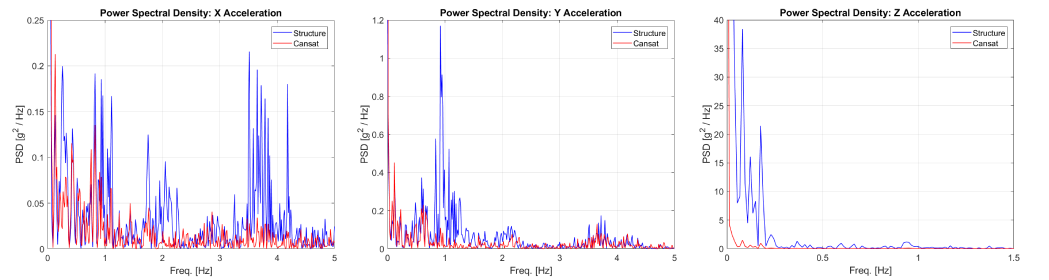
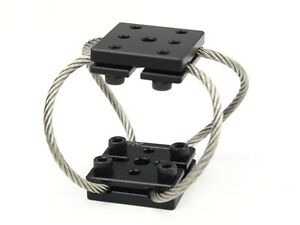
Our take on the “answer”, was to design and build a vibration damper that used the peculiar properties of non-newtonian fluids, and test its performance in flight onboard Eiger our newest rocket. We then wanted to compare it to those who already existed on the market.
As a quick recap, non-newtonian fluids are liquids that do not follow Newton’s law of viscosity. Most have their viscosity change when stress is applied onto them. There are multiple categories for those liquids, each with its own behavioral quirk. The one we were interested in displayed shear thinning properties, aka their apparent viscosity decreased with increasing stress. We also wanted to design a system that could dampen vibrations on the X-Y-Z axis.
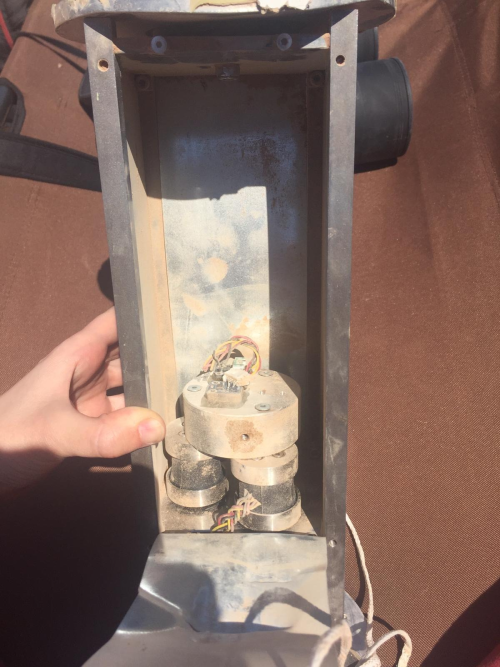
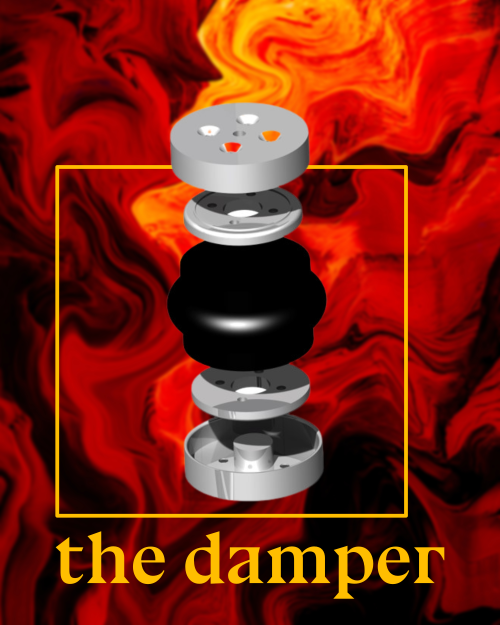
After six month, the final design emerged, looking like a futuristic take on Oreo cookies. A flexible membrane is filled with silicon oil and closed off with machined steel plugs.
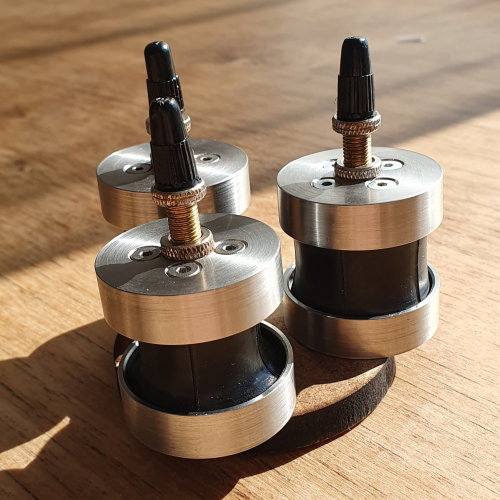
Those little cookies proved to be remarkably sturdy and effective.
They withstood a free-fall from 3000m and a crash at 250 km/h into the ground after our rocket partially failed to deploy its recovery mechanism, thus jettisoning the nose cone in which our ill fated payload was located.